
Cleveland, OH and Greater Cleveland
Composite Decking in Cleveland, OH
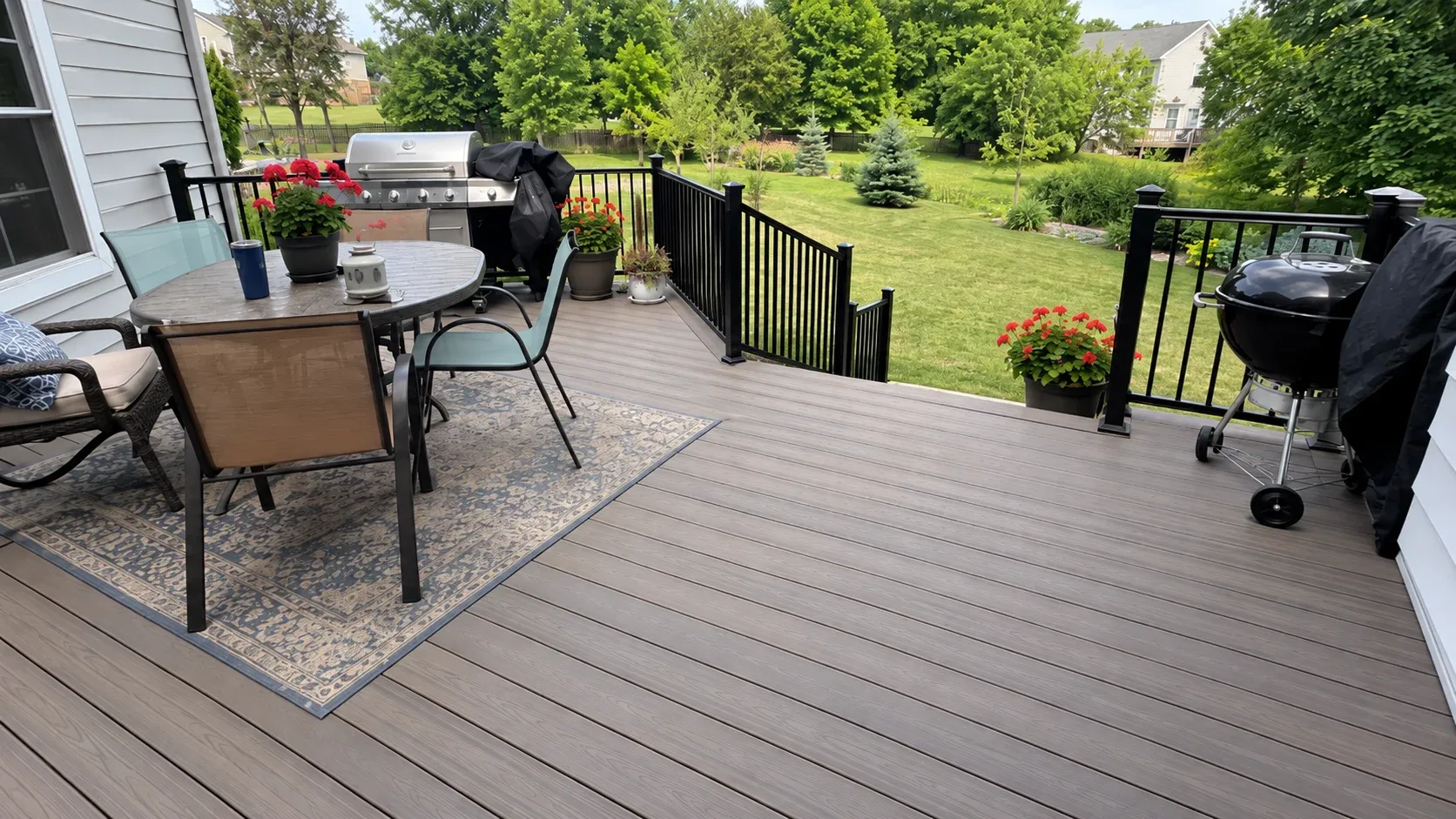
Capped composite and PVC decking fitted over a frame built for it. No sealing, no staining, and a surface that still reads the same colour after a decade of Lake Erie winters.
- Footings below the frost line
- Permits and inspections handled
- Written scope before we start
Cleveland Custom Decks fits capped composite and PVC decking across Cleveland and Greater Cleveland, over a frame built specifically for it rather than a treated frame with composite laid on top as an afterthought.
Composite has become the default request on most projects we quote, and the reason is less about looks than about a Cuyahoga County winter. A board that needs no sealing is one fewer thing to remember before the ground freezes.
What composite actually is
A wrapped core, not a solid plastic board
Most composite decking is a wood fibre and polymer core with a polymer cap bonded around it. The cap is what resists staining, fading and moisture; the core gives it the stiffness and screw holding power a solid PVC board does not need in the same way. Cheaper, uncapped composite from years past stained and mildewed for exactly this reason, and it is part of why the category earned a poor reputation it has mostly outgrown.
Where capped PVC differs
PVC decking carries no wood fibre at all, so there is nothing inside the board for moisture or mould to act on. It runs cooler underfoot than a dark composite in full sun, and most lines carry longer warranties. It also costs more, and on a shaded lot the difference matters less. We walk you through both before you commit to either.
Fitting composite correctly
Joist spacing tighter than treated lumber
Composite manufacturers publish a maximum joist spacing for a straight layout and a tighter one again for a diagonal pattern, because the board flexes differently to solid wood under a footstep. Framing at the spacing sold for pressure treated lumber and decking over it in composite is the single most common corner cut we find on a call out, and it shows up as visible springiness within a couple of seasons.
A taped frame underneath
Every joist and beam gets a butyl tape cap along the top edge before boards go down. It stops water sitting in the screw holes along that edge, which under this region’s freeze thaw cycle is where an untaped frame begins to fail first, whatever surface sits above it.
Hidden fasteners and expansion gaps
Grooved boards lock into a hidden clip system, leaving a clean uninterrupted field. Every board is gapped correctly at the ends and sides, since composite expands and contracts with temperature more than solid wood does, and Cleveland’s summer to winter swing is wide enough that skipping this step shows up as buckling by the second year.
Picture framing and border details
A contrasting border course, mitred at the corners, reads as a considerable upgrade for a modest material cost, since it is mostly a labour difference. Stair treads and fascia in a darker or lighter tone than the field is the other detail that reliably lifts a composite deck from ordinary to finished.
Choosing a colour and tone
Heat and glare
Darker composite absorbs more heat, and on a south or west facing Cleveland deck through July and August that shows up as boards genuinely too hot to stand on barefoot by mid afternoon. Lighter and mid tone colours stay noticeably cooler, and most manufacturers now publish surface temperature data by colour if you want the numbers before deciding.
Matching the house rather than the trend
A grey composite reads correctly against the brick and stone common on Cleveland’s older east side homes; a warmer brown tone generally suits the region’s abundant timber sided ranches and bungalows better. We bring physical samples to the site visit because a colour under a showroom light looks different laid on your own lawn in Ohio daylight.
Where composite makes the most sense
Full sun, low maintenance lots
Open, unshaded back yards common in the newer subdivisions further from the lake are the clearest case for composite: nothing to reseal, no colour change from UV, and no risk of a missed maintenance year leaving a deck looking neglected before a sale.
Pool and hot tub surrounds
Chlorinated splash and constant damp are exactly the conditions composite and PVC were built to shrug off, which is why the pool decking page leans on composite and PVC almost exclusively.
Households that will not maintain timber
If nobody is going to clean and reseal a wood deck on schedule, composite is the honest recommendation regardless of upfront cost, because an unsealed timber deck in this climate is silvered and splitting inside five years.
What we install it over
We build the frame first, sized and taped for the specific composite line you choose, then fit the boards, railings and stairs to match. See the full deck building process for how the frame and footings come together beneath whichever surface you pick.
Deck cost in Cleveland, OH
Plug in the dimensions and finish to see the installed cost range, no phone call required.
Your estimated cost range
$20,500$31,300
- Labour and installation$9,500
- Decking boards$6,500
- Railings$4,000
- Framing and hardware$3,000
- Footings and concrete$2,000
- Permit and disposal$1,000
Consider this a starting point rather than a quote. A no cost site visit and measurement comes first, and you get a locked in written price before any date is reserved.
Why homeowners pick Cleveland Custom Decks
Footings below the frost line
Cuyahoga County ground freezes and thaws through a long lake effect winter. Every post we set lands on a poured footing below the local frost depth, which is what keeps a deck level through a decade of heave and thaw.
Permits and inspections handled
We work out which department your address answers to, pull the permit, meet the inspector and hand you the signed card. An unpermitted deck becomes your problem the day you sell the house.
Written scope before we start
Materials, framing spec, hardware, timeline and price in writing before anybody swings a hammer. No verbal change orders.
Composite Decking questions we get asked
Is composite worth the extra cost in Cleveland?
For most households, yes, and the reasoning is climate as much as convenience. A timber deck out here needs cleaning and resealing on roughly a two to three year cycle to survive the freeze thaw swings and the rain that falls in every month. Skip that cycle twice and the boards are already cupping. Composite costs sixty to ninety percent more at the outset and asks for almost nothing afterward, which is the trade most owners who have already sealed one deck decide they would rather not repeat.
Does composite get slippery in a Cleveland winter?
A capped board with an embossed grain sheds ice differently to a smooth board, but nothing is immune to freezing rain off the lake. Keep the surface clear the same way you would a timber deck, and choose a lighter colour if the deck sits in shade most of the day, since dark boards that stay damp under a hard freeze take the longest to clear.
Which composite brand should I choose?
Trex, TimberTech, Fiberon and Deckorators all make a genuinely durable capped board, and the meaningful differences sit in the warranty terms, the colour range and the surface texture rather than in raw longevity. We fit all four and tell you plainly which one suits the look you described and the budget you gave us, rather than steering you toward whichever line pays the best incentive.
How is composite fastened so no screw heads show?
Grooved edge boards take a hidden clip system that locks into the groove and screws down into the joist from the side, so the top face carries no visible fixings. Square edge boards, used at borders and picture frame edges, take a colour matched face screw instead. Both are set to the joist spacing the manufacturer specifies, which on a diagonal composite layout is tighter than most homeowners expect.
Do I still need a permit for a composite deck?
Yes, the material does not change the permit requirement. What changes is the framing beneath it: composite needs closer joist spacing and a taped frame to meet the warranty terms most manufacturers publish, and we build to that specification whether or not the inspector checks for it, because it is what keeps the warranty valid if you ever need it.